Four core technologies, interlocking
An ordinary chatbot only does one question, one answer.
Meta Agent runs four technologies together, turning enterprise knowledge into AI productivity that is executable, verifiable and privately deployable.
Meta Agent Workflow
Ontology
Model Context Protocol
Frontier / Local / Hybrid orchestration

The four technologies, one by one
Each has a clear role, core strengths and use cases — with its workflow shown.
Meta Agent Workflow
Like hiring an employee — build a working AI workflow just by talking
An ordinary chatbot only does one question, one answer. What Meta Agent Workflow builds is an AI workflow that gets the job done step by step.
(Understand the request → Ontology builds the workflow → execute the task → produce the result)
- Build a working AI workflow just by describing it — no coding anywhere in the process
- Every step is checked before it runs, so answers aren’t invented
- Enterprise knowledge and data run through the whole cycle: understand · verify · execute
- Adjust it in conversation — no rebuild needed
- Switch industries by swapping the knowledge — no need to rewrite code
- Every customer’s data and permissions are isolated from each other

How we differ: most “AI Agents” on the market chain many prompts into a single opaque generation — the model decides its own path at run time, and you get the final answer with no step you can check. Optimus is a composable workflow in which every step is an explicit, inspectable, replaceable unit — keeping the flexibility of AI and the reliability of the answer.
Ontology
Knowledge graph plus a formal reasoning engine — it doesn’t retrieve an answer, it derives one
Ordinary AI retrieval only asks whether the meaning looks close. Give it a question with hard constraints — “5 days, 2 people, NT$30,000 budget, one guest allergic to seafood” — and it guesses, then asks itself to mark its own work. A language model is probabilistic: the arithmetic it gets right today it can get wrong tomorrow. Ontology organises enterprise knowledge into a clearly defined graph of entities, relationships and rules, and runs a formal reasoning engine over it. The model is called once, to compile the request into a rule; every comparison and inference after that runs on ordinary CPU — all constraints verified in 0.2 milliseconds, for zero tokens. The answer is not one that looks right. It is one that has been proven.
to verify every constraint — zero tokens, zero cost
hard-constraint violations, against 5–15% when a model checks its own work
fewer tokens — the rules live in the graph, not in every prompt
- It reasons, it doesn’t just match — it derives “A is open when B ends, B and C sit in the same district, C is allergen-free”, rather than returning a document that reads similar
- Hard constraints stay hard — safety, compliance, budget and timing are non-negotiable; if the logic does not hold, the AI has no authority to let it through
- Nothing invented when there is no exact match — hard constraints hold, soft preferences are relaxed in order and scored, and you get the closest feasible option instead of a fabricated one
- Every answer traces back — to the rule and the record that made it true: explainable and auditable, not a black box
- It cannot use data that isn’t there — before assembling a workflow it introspects the graph for what the domain actually holds; with no flight data, it cannot even produce a book-a-flight step
- Verified logic is remembered — the same shape of problem reuses a proven rule and skips the model entirely, so the system gets cheaper and faster the longer it runs
- Change industry by changing knowledge, not code — a medical scheduler or a wedding planner is about a week of graph work, against four to eight weeks of prompt rewriting
- Language-independent — the graph stores concepts and relationships, not phrasing

How we differ: the common approach is to write the rules into the prompt and ask the model to review its own work — using probability to guarantee certainty. Optimus hands the arithmetic to formal logic and keeps the judgement for the AI: 100% correct where it has to be, still flexible where it should be.
MCP · Model Context Protocol
The universal adapter of the AI world — plug your existing systems into AI
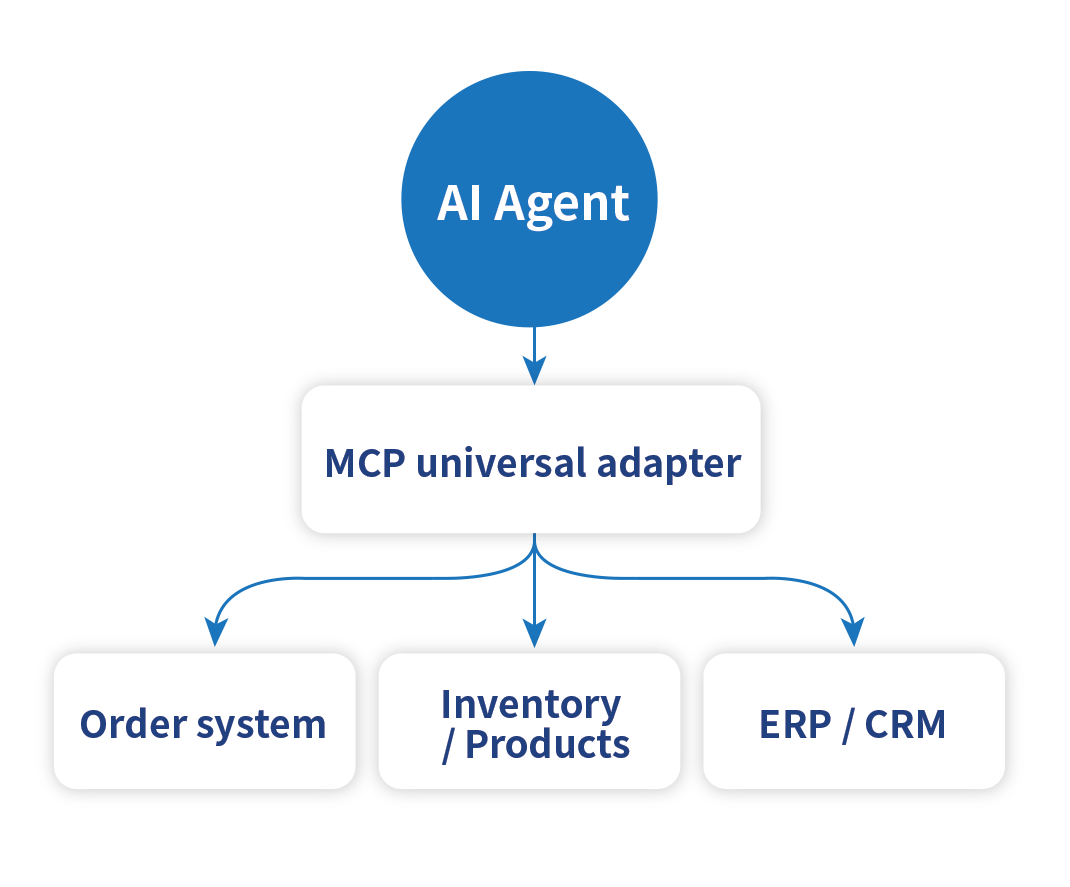
Enterprises already run order, inventory, customer and ERP systems. MCP is an industry-standard adapter that lets AI read from them safely — even place an order — without changing any of them. We wrapped a travel ERP as an AI-callable tool: adding a capability is a configuration change, not a rewrite.
- Connect to enterprise systems through an industry-standard protocol — no need to replace what you have
- A travel ERP is already exposed as an AI-callable tool
- Add capabilities by changing configuration, not by rewriting code
Frontier / Local / Hybrid orchestration
Private data is always de-identified before it reaches a cloud model
Finance, healthcare and government care about one thing above all: the data must not leave. All-cloud delivers quality but raises doubts; all-on-premises is safe but ties your hands. Riversoft doesn’t force that choice — the system routes by task difficulty and data sensitivity: the most sensitive work stays on a Local model inside the enterprise, and only complex reasoning goes to a Frontier cloud model, de-identified before it leaves, with the re-identification mapping kept on the customer’s side. The cloud model never sees data that identifies a person.
- Data is de-identified before it reaches a cloud model; the re-identification mapping stays on the customer’s side
- Local: sensitive tasks run on in-house models — the data never leaves
- Frontier: complex reasoning goes to frontier cloud models, with no compromise on quality
- Hybrid: chosen automatically by task and sensitivity — no manual call needed
- Components can be deployed in the customer’s own data centre, with strict per-customer data isolation

How we differ: not cloud-only by default. Data sovereignty is designed in, so you get the quality of cloud models and the privacy of on-premises at the same time.
Technical advantages
The advantages come from one architecture: AI handles the understanding, the reasoning engine does the thinking. It fixes the three worst problems of ordinary AI at once — making things up, burning money, and being hard to trust.
Tokens saved per run
No made-up answers
Far lower cost
Cheaper and faster the more you use it
Safer against over-reach
No answer beats a wrong one
Use cases
One technology stack — load a different domain’s knowledge and it lands in a different industry.